
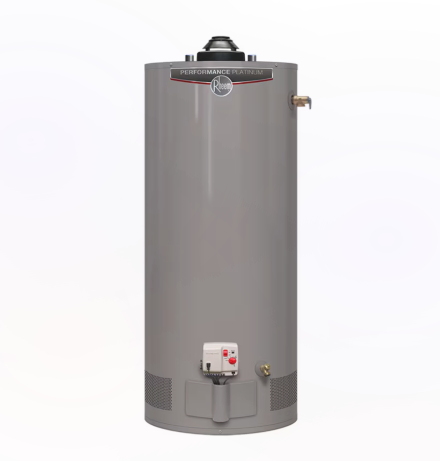
If you’ve already got a Rheem water heater installed or you’re looking at purchasing that model, you might be wondering “What are the common problems with Rheem performance water heaters?”
To help customers understand the common issues, we’ve created this guide listing some of the problems associated with this model.
Diagnosing Rheem Ignition and Flame Failures (Codes 11 & 12)
Rheem error codes 11 and 12 indicate distinct combustion control failures. Code 11 signifies ignition trial failure where the board detects no flame within the allotted time. Code 12 represents operational flame loss after successful ignition. Diagnosis requires specific electrical measurements rather than component swapping.
- Code 11 Verification: Perform dynamic gas pressure tests to ensure inlet pressure meets specifications while the valve is open. Insufficient supply triggers premature lockout. Professional gas manifold pressure testing confirms regulator function under load.
- Code 12 Verification: Measure microamp readings at the flame sensor rod. Signals below 0.5 µA indicate poor grounding or sensor contamination. High impedance prevents the board from sustaining the safety circuit. Ensure proper polarity during measurement.
Verify gas flow integrity and flame rectification stability before replacing electronics.
Resolving Thermal Cutouts and Exchanger Scaling (Codes 14 & 16)
Rheem error codes 14 and 16 represent hard thermal lockouts triggered by excessive tank temperature or restricted water flow. These safety shutdowns prevent catastrophic failure but indicate severe maintenance needs requiring intervention.
- Code 14 stems from thermistor faults or high-limit switching due to scale buildup insulating the burner assembly from proper feedback.
- Code 16 indicates flue gas overtemperature, resulting from blocked internal heat transfer surfaces trapping hot exhaust gases in the combustion chamber.
- Diagnostic steps involve measuring NTC thermistor resistance values against manufacturer specifications using a calibrated meter.
- If electrical components test within normal ranges, physical removal of accumulated mineral deposits becomes mandatory for restoration.
- Chemical heat exchanger descaling restores thermal conductivity and ensures normal cycling behavior returns safely without risking sensor damage.
Combustion, Airflow, and Code 99
Rheem Error Code 99 indicates a critical hard lockout triggered by imperfect combustion detection. The control board initiates an immediate shutdown upon sensing unsafe exhaust levels or insufficient air supply during operation. This fault mandates physical verification of the combustion assembly rather than attempting a simple reset.
- Inspect the sealed combustion blower motor for winding resistance failures or capacitor degradation preventing proper operating speed.
- Examine heat exchanger internal fins for heavy soot accumulation restricting internal airflow pathways significantly.
- Verify external termination caps remain clear of nesting debris, snow blockage, or wind back-pressure issues.
- Perform ventilation restriction diagnostics to confirm draft performance meets engineering specifications under load.
Address airflow integrity before replacing expensive electronics components. Unresolved obstructions pose significant carbon monoxide hazards to residents. Always verify fan rotation direction with the installation diagram before condemning the motor assembly prematurely.
Tank Model Diagnostics: ECO Trips and Pilot Drops
Rheem traditional tank water heater models exhibit safety lockouts primarily through Energy Cut Off (ECO) activation circuits or pilot flame instability mechanisms. These critical failures stem directly from internal electrical faults within the thermostat assembly or significant thermocouple degradation rather than random control board logic errors.
- Frequent ECO high-limit trips indicate upper thermostat contacts are welded shut permanently or a heating element has shorted electrically to ground against the metal tank wall. Isolating these specific voltage leaks requires replacing a grounded heating element immediately to prevent catastrophic burnout scenarios for the unit.
- Pilot drops occur unexpectedly when thermocouple voltage falls below critical millivolt thresholds under actual operational load conditions. A healthy sensor must always read 25-30mV unloaded during steady-state conditions consistently.
- Verify wiring integrity specifically between the pilot generator output and gas valve solenoid coil resistance values accurately with proper metering equipment.
- Do not reset ECO repeatedly without addressing underlying thermal runaway risks from faulty limit switches preventing safe system restart procedures entirely.
Condensate System Lockouts (Codes 92 & 93)
Rheem Error Codes 92 and 93 manage condensate disposal safety on condensing units. Code 92 serves as a soft warning for neutralizer media exhaustion while heating continues. Code 93 enforces a hard lockout preventing combustion once secondary trap integrity fails.
Condensing models generate acidic condensate requiring pH neutralization before drainage. Depleted media allows acid buildup to corrode internal PVC piping and heat exchangers. Control boards monitor pressure switches linked to condensate line status. Triggering Code 93 mandates condensate neutralizer replacement to restore service cycles. Preventive maintenance avoids irreversible unit corrosion caused by acidic drainage back-pressure. Ensure drain lines maintain continuous downward pitch to avoid false positives during operation.
Frequently Asked Questions
Rheem Code 99 is a hard lockout indicating severe combustion air restriction. It is typically caused by a failing blower motor, blocked heat exchanger fins, or an obstructed vent termination, requiring a thorough inspection of the air path and blower motor current.
A Code 12 indicates flame loss during operation. Test the flame rod by measuring the DC microamp (µA) signal in series with a multimeter. A healthy flame rod should produce a steady reading; fluctuations usually indicate carbon fouling or a weak chassis ground.
Frequent ECO (Energy Cut-Off) trips usually point to a grounded heating element or welded contacts within the upper thermostat, forcing continuous heating. You must verify element integrity by checking for continuity to ground.
Code 92 is a soft usage warning indicating the condensate neutralizer is nearing the end of its lifespan. Code 93 is a hard lockout triggered when the neutralizer has fully expired, shutting the unit down to prevent highly acidic condensate drainage.
Code 14 is a thermal cutout caused by overheating. In hard water areas, this is almost exclusively caused by scale buildup restricting water flow through the heat exchanger, requiring a chemical flush using a dedicated descaling pump.